




 © Lionel Beck - North Yorkshire - UK






 From Yorkshire Pudding to Pizza in Pisa
Come with me to Italy. I'm afraid the transport is somewhat basic: you’ll be riding on the back of
my words. Hold tight! I’ll write carefully, trying not take too many sudden diversions, and
avoiding unexpected full stops.
Going off the Rails
Mental contortions! Booking a place on Belgian Railways "Motorail" - or as they call it, the
"Autotrein". It’s not possible to make reservations more than 6 months in advance. I telephone
Belgian Railways in London as soon as I’m in the 6-month time frame and make the booking. We
intend to get the train from Denderlooew (near Brussels) to Livorno in Northern Italy (near
Pisa).
Weeks go by and no word from Belgian Railways. I email them and they reply that our booking
request has been "placed in a queue in Brussels". "There is every chance you will get on this
train". This does not fill me with confidence.
Belgian Bonhomie
The rail tickets arrive! But - what's this? .. there is one for us and one for the car - fair enough -
but they have different train numbers on them. I imagine us heading off in one direction and our
car in another. I email my (by now) familiar Belgian Rail contact, and ask if I should be
concerned. He replies ..
"We will ask Hercule Poirot to investigate this mystery. Sorry, this is just my weird Belgian
sense of humour. It is perfectly normal to have different train numbers for passengers and cars
whilst still indicating the same train ... but only in Belgium!
Kind regards, Daniel Mahr.”
A1 South
We've paid £17 for a Swiss Motorway pass. It's valid for a year, but we’ll only use it for one day;
but it's a one year pass or nothing - Swiss Justice! We've also become temporary millionaires:
this is just before the Euro, so we have 1.5 million Italian Lire between us! (£1 is approx 3,000
Lire.)
It's Saturday 18th August and we are off to Folkestone on the south coast for an overnight
stop before driving on to Le Shuttle to take us under the English Channel.
We shall take the A1 south, then M11 to the London area and M25 then M20 to Folkestone. At
the start of one section of the A1 in Lincolnshire I see a sign ..
Being in possession of a notoriously attention-seeking bladder on long journeys, I take
this as sound advice!
At a roadside restaurant for lunch I decide to start our Italian experience early by having
Chicken Fusilli (noting the invaluable information on the menu that Chicken Fusilli is also
available "without the chicken"!).
It's 7 pm as we turn off the M20 into Folkestone after a pleasantly unhurried 300-mile journey.
Rough Start to a Smooth Crossing
It's Sunday 19th August, and it’s 6 am; I've just had a nasty feeling that the train I had
booked for the channel crossing might not give us enough time on the other side to reach
Denderlooew in time for the Autotrein.
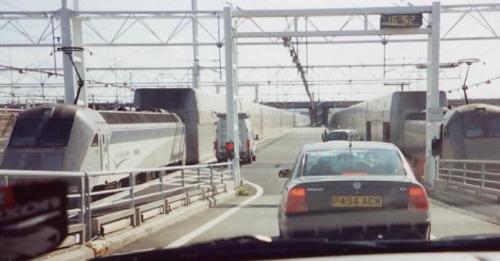
I want to catch an earlier train so we are heading for the Tunnel Terminal an
hour earlier than planned. Sod's Law comes into play. We arrive and are told:
"Normal service has been suspended. Train stopped in tunnel." A group
of illegal immigrants from Calais have been discovered walking the tunnel.
(Good grief! Do these people realise this is a 25 mile walk - in a tunnel - with
trains thundering by at 70 mph every 15 minutes?)
After sitting around for a bit, panicking about missing our Autotrein, we’re told that things are
getting back to normal and we can catch the 8.20 train. This was the train I had originally
booked! We get an uneventful journey under the Channel and an easy 100 mile drive on the
French and Belgian Autoroutes to Denderlooew.
(Years ago, when we made our first trip to France with a car, driving on the "wrong" - that is to
say, the right hand side of the road filled me with terror, and my fear and tension stayed with
me for nearly an hour's driving. Now I find that within a couple of minutes driving I'm quite
relaxed and comfortable.)
Railway Tracks and Sleepers
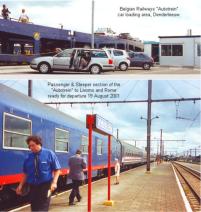
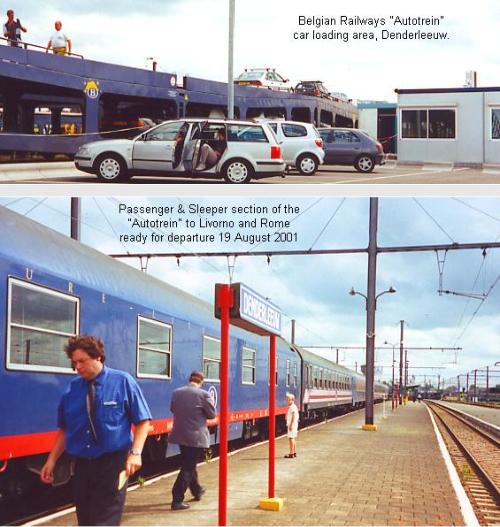
The Autotrein terminal is an interesting experience. We are parked up on a large concrete apron,
through which the railway tracks run (like your average level crossing) and there is a motorised
ramp being manoeuvred up to the end of a line of double-decker car transporter wagons. Some
wagons are for Rome, others for Livorno (our destination). The cars have to be loaded in the
right order on to the right wagons.
I get the car on to the wagon and return to the departure lounge. Meanwhile,
after all the cars have been loaded and secured, a little diesel shunter rumbles
up and hauls the car wagons away up the line. Goodbye, cars.
We walk through a tunnel to the main station and find our train waiting. The car
section of the train has by now been taken up the line to a junction and is now
being shunted back down to us and coupled up to the end of our train. Hello,
cars.
Each carriage has its own steward (multi-lingual). Ours is a Flemish speaking
Belgian who speaks good English, and he shows us to our cabin. In it's day-time
mode the cabin has comfortable seats, coat hooks, a storage shelf, and a
washbasin with hot and cold running water. Above the shelf are cupboards and these include
two sealed plastic cups of water for teeth cleaning.
We pull out on time at 2.20 pm, and start our long journey. The steward brings us each a
complimentary glass of wine - a good start!
Our train will spend the rest of the afternoon trundling through Brussels (Bruxelles), Namur and
Dinante, before crossing into France for Thionville and Strasbourg, (by which time it is early
evening, since we have had an unexplained stop for an hour near Namur).
The train has been displaying some impressive turns of speed but unfortunately round some
equally impressive curves, leading to hairy moments whilst negotiating the corridors for toilets,
and indeed heading for the restaurant car at about 7 pm. The restaurant car is a delight of
modern décor, with attractive lighting, and a creative table layout that includes tables for four,
two, and even single people.
The dinner menu is in several languages, including English. The Parma ham and melon, followed
by steak in peppered sauce, and a bottle of Chardonnay satisfy hunger and thirst more than
adequately, and the waiters somehow contrive to stay on their feet whilst serving food and drink
as we negotiate more curves at about 80 mph.
On our return to our cabin a we find that the steward has converted the seating into two bunk
beds, one above the other, and a ladder fixed in place. Although I am happy with the concept of
"women on top", I climbed the ladder as we hurtled round several more bends.
An interesting night! The train is travelling at speed, the track doesn't get any straighter (quite
the opposite), and there are frequent tunnels. It’s hot, and the air conditioning is on the blink, so
we open the window. This results in incredibly high noise levels, especially in and out of the
tunnels as we speed through the blackness of nocturnal Switzerland, swallowing up Basel, Bern,
and Brig.
To add to the noise comes a severe electrical storm so the cabin is lit by occasional blue flashes.
The whooshing of the tunnels is augmented by rumbles and bangs. Stir into this cocktail the fact
that we are now lying in bunks across the width of the cabin, and travelling at about 80 mph at
900 to our line of travel. As we take each one of the many bends centrifugal force slide us first to
one end of the bed, then to the other, alternately banging feet and heads against opposite cabin
walls.
Sleep comes and goes, interspersed with quiet periods at a standstill in some station or other,
listening in semi-consciousness to station announcements, sometimes in French, sometimes in
German. Then we’re hurtling through the night again, but eventually there are glimmers of early
daylight and we stumble out of the bunks and do our best to wash and dress in the confined
space. As we penetrate more and more tunnels entering northern Italy we lurch down the
corridor again to the restaurant car for breakfast.
The scenery outside is staggering. High mountains, and the typical architecture of Italian towns
climbing up them on one side of us, and the waters of the Rivereria di Levante on the other, as
we negotiate the area round Genoa and La Spezia. It's a spectacular accompaniment to our
breakfast of coffee, croissants and jam.
Now the train has stopped at Pisa Station - quite the scruffiest looking station I have ever seen -
and we are standing in the corridor watching people getting on and off the early morning
commuter trains. We wonder if we’ll see the famous leaning tower as we pull out of the station,
but all we get is industrial estates.
It's now nine o'clock in the morning of Monday 20th August as we pull into Livorno. This is
where we get off, and we should have arrived here at 7.30 am. Still, being used to the chaotic
system that passes for train travel in Britain, this almost feels punctual!
We hump our luggage on to the platform and there's a station announcement in three languages
- "Collect cars at the ramp". This is useful but for the fact that nobody knows where the ramp is,
(or indeed what it is). Welcome to Italy. It is already very warm.
Now there are people wandering about lugging suitcases saying to each other "Where the hell do
we pick up our cars?" Someone finds an official who tells us where "The Ramp" is and off we
troop. The car transporter wagons for Livorno are shunted off the end of our train, taken down
the line, then back up on another line, arriving at "The Ramp". Meanwhile, the train that has
been our moving home for 17 hours pulls out, heading for Rome.
Driving on the Right, & trying to keep out of the Wrong, in Italy
Monday 20th August.
With a head full of stories and rumours about the lethal nature of Italian driving I drive nervously
out of Livorno station relying on my instinctive internal navigation system. (The map of Livorno
provided by Belgian Railways is useless as there’s no indication where the roads are heading as
they fall off the edge of the map.)
We see a signpost for Rome, and we remember that this road will take us to where we can pick
up the rural road for our destination - Casole d'Elsa and the Hotel Gemini.
We have a 60-mile drive to our hotel, and we have all day to do it in. I have already been hooted
at by an impatient gesticulating Italian driver as I attempted to find the right road out of
Livorno. Soon the universal disregard for speed limits, and the popular past-time of driving as
close as possible to the car in front ceases to cause panic, as we get into the Italian swing of
things.
We see little in the way of road repair works in Italy, but they need them. The rural roads have a
marked tendency to crumble away at the edges, and the Italian highway authorities simply erect
road signs showing a picture of a road with the edge crumbling away, and they are permanent
signs! If you think British roads have too many bends, try the rural Italian ones (and this is the
home of the ancient Romans who took the shortest distance between two points, thus inventing
the straight line!) The "Autostrada" (the toll motorways) on the other hand, are superb.
The scenery is great, and we are (of necessity) driving slowly enough to enjoy it: rolling hills,
rows of cypress trees; mediaeval towns perched on hill tops, with the road winding up and up,
hairpin bend after hairpin bed to the edge of town, then down the other side in similar manner.
We stop for a break on a hill top and survey the hot, shimmering countryside. The noise of
millions of crickets in the grasses is amazing - difficult to describe in words - a bit like several
hundred football referees blowing their whistles from somewhere about 2 miles away. There is
not a cloud in the sky and the sun is burning down mercilessly. We cannot remember when we
were last as hot as this. Thank God for Climate Control in the car!
Onwards to the mediaeval town of Volterra and beyond, and by midday we
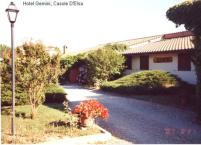
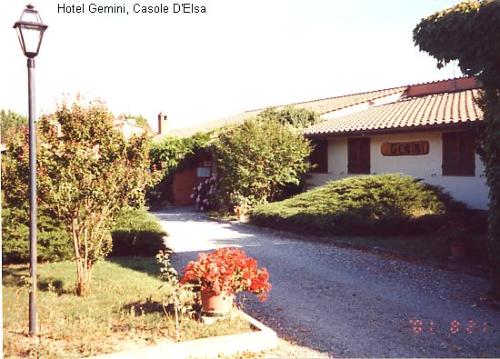
are pulling into Casole d'Elsa and the Hotel Gemini - at first sight a small
single-storey building when viewed from the front. But it is built into a hill
side and the ground falls away sharply behind the hotel, so that in fact there
are two more floors - below the reception, lounge and dining areas - which
you cannot see from the front. So, after registering we take the lift down
two floors to our bedroom. It's a large and airy cool room and, having gone
down two floors, we discover that the large French windows open out
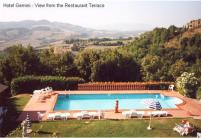
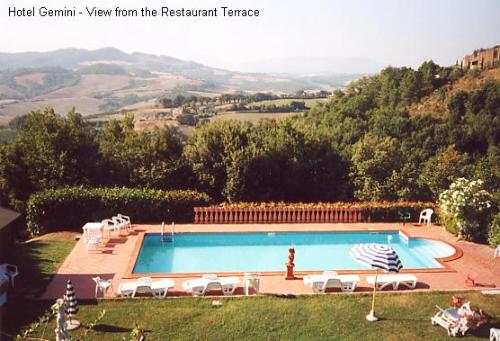
directly on to a level garden. We have our own little patio, with chairs and table, from which
we can view the swimming pool.
Strength in Numbers
Lunch in the hotel restaurant. I learn to say our room number in Italian for the benefit of the
waiter, (due-zero-quattro) and he proudly translates it back into English as two zero five so then
I have to advise him that it is two zero four so he rolls that off his tongue a couple of times and
is then very happy. I order duck in orange sauce. Potatoes only seem to be available in one form
- so we ask for the patate fritte - which the waiter triumphantly confirms as - "chips!" (This is
going to be a little ritual performed every evening at dinner.)
My Italian is like my French and my German - phrase book stuff. But I can pull off a fairly
convincing accent, sadly thus appearing to be more fluent than I really am. Frequent use of the
phrase of "Scusi, non parlo Italiano molte bene" invariably elicits a response that I don't fully
understand but clearly indicates something along the lines of "On the contrary, you speak it
very well! Much better than my English in fact!" After this they are waiting for you to continue
with your obvious fluency. The trouble with learning useful phrases and questions is that
however well you deliver them, there's an even chance you won't understand the answers!
Still, my luck is in as I approach the Receptionist, requiring a couple of extra pillows in the
bedroom. I have rehearsed "Scusi, possiamo avere due cuscini
supplementare, per piacere" - to which she replies "Si, certamente."
The hotel restaurant opens out on to a terrace providing a breathtaking view
of the Tuscan countryside, so we choose to sit outside. We have dinner
(parma ham and melon, followed by smoked swordfish, vegetables (and
Chips!) with, of course, a bottle of Chianti) sitting under a darkening purple
sky in which hangs a thin crescent moon. There is a warm breeze. Absolute
bliss.
City of Towers
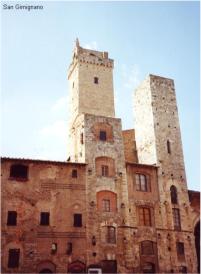
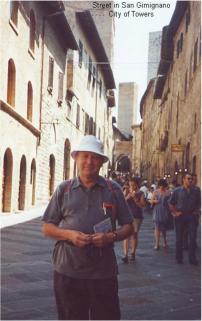
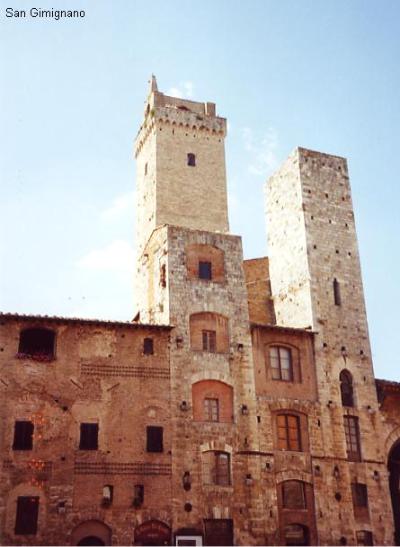
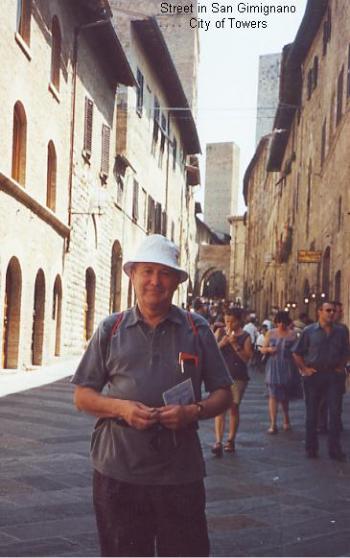
It's a hot and sunny Tuesday and it’s half and hour's drive to the medieval town of San
Gimignano. In the 13th century this town boasted 76 towers serving both as fortresses and
symbols of private wealth. Today there are only 14 remaining, but they still make a spectacular
sight.
It’s a tourist trap par excellence and at 10 am approach roads are already very busy, and the car
parks on the outskirts of the town are nearly full. This place is a web of narrow streets and
alleyways, and except for those belonging to local residents
no cars are permitted.
Oops! - the notorious bladder calls for attention, and as
luck would have it there are public toilets near one of the
entrances to the town. But what's this old guy doing sitting
at a table outside? Collecting money from all these people
with crossed legs queuing, that's what he's doing. I ask him
how much; he just shrugs his shoulders. Peering (no, not
peeing) into the box on his table I see a large collection of
1,000 lire notes, so that is what I give him. Well in terms of
facilities and cleanliness it was well worth the money.
(About 30 pence). But there's a big surprise for the ladies -
instead of the expected lavatory bowl and seat there are
those traditional "hole-in the-floor-stand-and-squat"
arrangements so well known in some rural parts of France.
Some Japanese ladies came out of the place in a visible state of shock.
Forgive me for waxing lyrical on things anal, but I feel obliged to record that after our
expedition to the Czech Republic the previous year - where the texture of toilet paper was
somewhere between that of a cheap kitchen roll and a brown paper bag - the Italian variety
provides an acceptable experience.
We spend the day wandering the ancient and narrow streets, and we include a contemplative
visit to the Basilica. Here I light a candle for all who are dear to me - well, not exactly a candle -
here in this mediaeval cathedral you pop a coin in a slot and an electric "candle" is switched on!
Lunch in a little ristorante opening out on to the street. As a somewhat perverse aid to post-
lunch digestion we decide to visit the Museum of Inquisition Torture and Capital
Punishment, where our senses are assaulted by displays of the most appalling instruments of
torture used through the ages, in Italy, and world wide. Even more disturbing are the graphic
descriptions of how and why they were used, and how long the victims usually took to die. It is
difficult to place these things in any order of awfulness, though I think the one at the top of my
personal list is the tall upturned tapered spike, on top of which the victim is sits, waiting to
submit to the laws of gravity.
Later we suffer another form of torture: Ordeal by Rejected Credit Card. We want to buy a set of
unframed prints of Tuscan scenes. The shop owner takes my credit card, swipes it through his
scanner and it’s rejected. I proffer a second card - same result. Same with the third and fourth
cards. I wonder if someone has raided my bank and credit card accounts; the apologetic shop
keeper assures us this is a fault in the Italian telephone system! I have some £ sterling, so off
we go to a bureau de change across the street and change it to God knows how many hundreds
of thousands of Lire, return to the shop and pay for the pictures with cash.
We return to our hotel for our evening dinner on the terrace - rabbit in truffle sauce (oh, and
Chips!)
Bread - the Tuscan Variety of Pane is a Pain
Wednesday 22nd August, and we decide to stay local. We wander round Casole D'Elsa, look in
on a small supermarket and buy ourselves a "picnic" lunch to eat in the hotel garden.
We have already noticed at breakfast that Tuscan bread leaves much to be desired. It is dry and
tasteless. (We learned later that it is normally like this, having no salt in it, and is also baked in a
way that produces a rock hard crust.)
In our quest for a picnic lunch we examine the bread counter in the local supermarket. I pick up
a long loaf, and waving it around, remark, "I could kill someone with this!" Fortunately, nobody
here speaks English.
In the hot afternoon I decide to splash around in the hotel's outdoor swimming pool. The air
temperature is so high that the water seems unpleasantly cold at first, and my important bits
shrink even smaller than they already are. But I soon get used it.
A Fool and His Money are Soon Parted
Thursday 23rd August. We are going to visit Florence. (I hope she's in.) It’s a
50 minutes drive; we’ve studied the city maps for car parks. On arrival we find
the road leading up to the Piazzala Michelangelo, high on a hill overlooking the
city. Again, not a cloud in the sky and the sun is beating down. We are going to
need our sun hats, especially with my bald bonce.
As soon as we park the car we are the victims of a scam. A “car park attendant”
waves us into a vacant spot, writes out a ticket, sticks it on our windscreen, and says in good
English, "30,000 Lire for the day please". This is about £10, but what the hell, this is Florence
(Firenze) and it's bound to be expensive.
Another English car drives up beside us. The guy gets out and says, "You didn't pay him, did
you?"
"Well, yes, actually."
"It's all free in this spot. You see the white squares? That's free parking. You only pay where
there are blue squares."
"So where are the blue squares?"
"There aren't any!"
"Aaaargh!!"
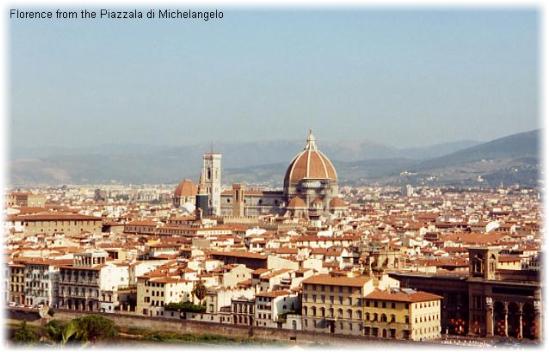
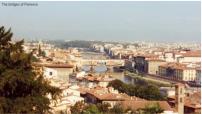
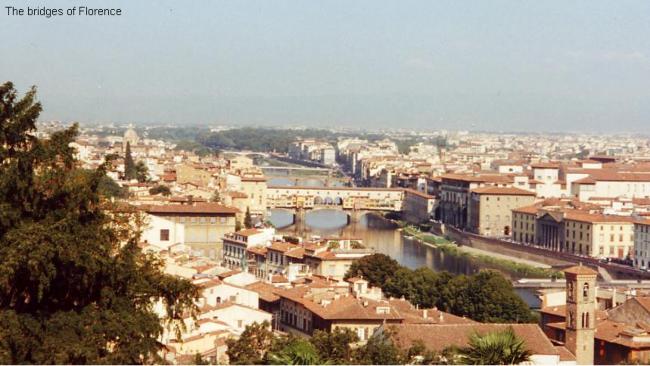
By now we have just clapped eyes on the view - the whole of Florence spread out beneath us,
with the dome of the huge Duomo (cathedral) dominating the picture, and we can see the
famous Ponte Vecchio - the oldest bridge in Florence, (crossing the River Arno), built in 1345,
with shops and buildings on it These were originally butchers, tanners, and blacksmiths, but they
were evicted by Duke Fernando in 1593 because of the noise and the stench. Nearly all of these
buildings are now jewellery shops. Suddenly it almost seems worth 30,000 Lire.
Across the Ponte Vecchio we go, and then into the city. All the police that were needed up on the
hill are down here in the town; on every street corner, chatting and smoking: Carabinieri - the
armed "military" police with red-striped blue trousers and peaked caps; (they deal with a variety
of offences from theft to speeding); La polizia - the state police with blue uniforms, white belts
and berets; (they specialise in serious crimes). And the Vigili Urbani - the municipal police with
blue uniforms and white helmets (same shape as the British Police helmet); (they regulate street
traffic). There are a lot of females in this last group, and they all seem to have shoulder length
hair, looking very odd when topped with a tall white helmet! With all three varieties of police it
seemed to me there was a good case for a fourth - perhaps the Vigili Parcheggio? (Parking Lot
Cops?).
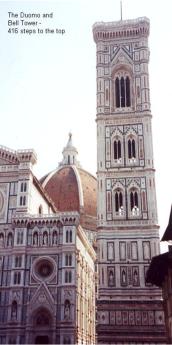
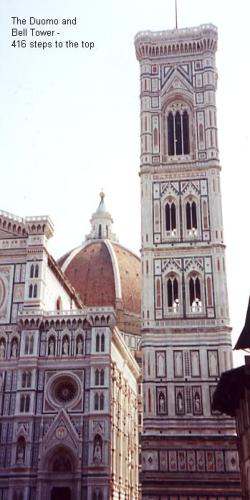
The Duomo, or cathedral, is colossal, but the close configuration of the surrounding streets
makes it impossible to see it all at once. Our first sight of the front is an amazing assault on the
senses - gleaming black and white marble. We join the queue to get inside. The main sense
inside is one of an awesome space, (it can accommodate 20,000 people) but having already
seen the startlingly ornate exterior, the interior appears to be quite plain by contrast.
We light a candle for Jacqueline.
Dante's house is quite close by, but being very hot, and short of time, we didn't see it - an
infernal disappointment.
Next to the cathedral is the Campanile, or Bell Tower, 276 ft high - again black and white marble.
I slog up to the top - 414 steps! Stunning view, buggered legs.
It's time to find somewhere for some lunch before we collapse from heat
exhaustion. So we return to the river, near the Ponte Vecchio and find a riverside
bar where we have a cold beer to wash down a toasted wild boar ham and
tomato roll, whilst listening to four American women on the next table alternating
between English and fluent Italian.
Then we retrace our steps in the direction of the Duomo, this time taking in the
Piazza della Signoria and the Palazzo Vecchio, outside which we can feast our
eyes on Ammannati's Neptune Fountain and Michelangelo's David. Inside the
Palazzo is a museum, and we try to get in, but - hey! - this is Italy, in the height
of the tourist season, in the middle of the week, and so the museum is about to
be closed for the afternoon! Unbelievable! Still, the shop is still open, so we can
buy books on Leonardo da Vinci and Michelangelo.
After rubbing the nose of the lucky bronze boar in the nearby marketplace we re-
cross the Ponte Vecchio and make our way to the Palazzo Pitti where we collapse
gratefully into an air-conditioned café for fruit tart and coffee.
Our car - after the rigours of being on a railway transporter wagon's lower deck through
thunderstorms, and subsequent storage in the very dusty hotel car park - is by now disgustingly
filthy, so on the way back we pull in at a garage and put it through a car wash. This removes the
dust, but there are still rusty looking stains on it from the train journey. Back in the hotel by 6
pm Dinner on the terrace by moonlight.
Australian in Siena
It's Friday 24th August and still sunny and very hot. We spend the morning in the hotel
garden; I position myself under the shade of a small tree and get stuck into the biography of
Michelangelo.
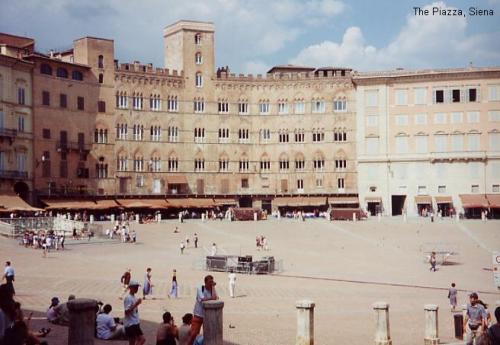
We decide to skip lunch and take a half hour drive south to the ancient town of Siena, parking
the car outside the old city walls and walking through the city gate and down one of the narrow
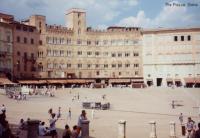
streets that form a kind of web radiating out from the central Piazza del Campo. These streets
are no-go zones for cars but of course there is always the ubiquitous motor scooter. There are
more of these in Italy than you can shake a stick at, and are constant noisy hazard sounding like
bees in a jam pot, in the narrow streets and alleys of mediaeval towns.
The Piazzo del Campo is surrounded by bars with chairs and tables under
awnings and sunshades outside. Collapsing gratefully into chairs outside one of
these bars I summon up my best Italian to order a couple of beers. An
Australian accent you could cut wood with came back ... "D'ya wanna do this
the Italian way or the English way?". We opt for the English way! (What's the
point of trying to talk Italian to an Australian?)
The Duomo is another black and white marble marvel, and inside there is a
fantastic inlaid illustrated marble floor. Unlike the Duomo in Florence, this is one is as startlingly
beautiful inside as outside.
I sit down in the main body of the cathedral to rest the poor old pins and to study all the
international tourists. An American is carrying around one of these tape-recorded information
systems. He approaches a member of the cathedral staff and is clearly agitated ...
This system is broken - I want my money back. I can't wait for a replacement, because
I have to go and meet someone."
"How much have you heard?"
"I guess about half."
"Come back again tomorrow and you can hear the other half."
We leave the cathedral before World War III breaks out. The rain is now coming down in lumps,
but soon stops.
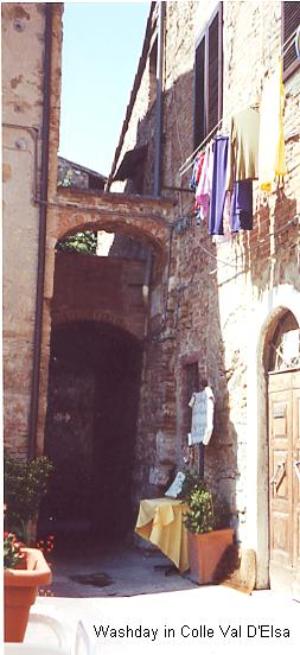
We drive back to the hotel via a medieval hill-top town called Colle di Val D'Elsa, and decided to
stop there for our evening meal. (Arnolfo di Cambio, the man who built the Palazzo Vecchio in
Florence, was born here in 1232.)
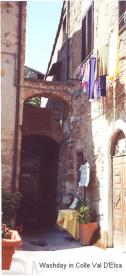
We walk into a little square shaded by trees. The entrance to the old town proper is
through an archway going right through the middle of an old house that straddles the
road.
A couple of hundred yards down the main street we come across another little square
surrounded by ancient houses with tiny windows. On one side is a little café bar with a few
chairs and tables outside. It is clearly a popular little haunt of the local townspeople, so
we decide this is going to be the place for a simple meal this evening.
Out come the cold beers, of course, and I choose a vast selection of pieces of local
cheeses arrayed in a circle around the plate, and a great pile of sliced Tuscan bread (no
butter). The cheeses were very good and compensated for the bread!. My wife had a ham
and cheese toasted roll. She conclude that toasting Tuscan bread brings about some
improvement. I'm driving, so no more drink for me, but my good lady (having demolished
a large beer) decides to have a glass of wine. The climax to this simple repast are two
large chocolate ice creams swimming in Grand Marnier liqueur, accompanied by cups of coffee.
All this comes to a mere 47,500 lire, i.e., about £7.50 each for a great little meal, sitting outside
in a sunlit square surrounded by ancient buildings with character occupied by interesting
characters!
As Big Ben said to the Tower of Pisa, "I've got the time if you've got the inclination".
It's Saturday 26th August, - hotter than ever! We can't leave Italy without seeing the leaning
tower of Pisa, and this is our longest drive of the week, but the countryside is great and we pass
through some nice little towns and villages.
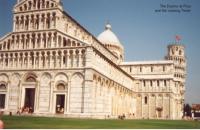
Two hours later we are in Pisa, and I've left the street map behind, so we are wandering around
looking in vain for a tower, leaning or otherwise. Because of the narrow streets it is difficult to
look for landmarks. We've nearly given up when suddenly we just see the top of the tower, so we
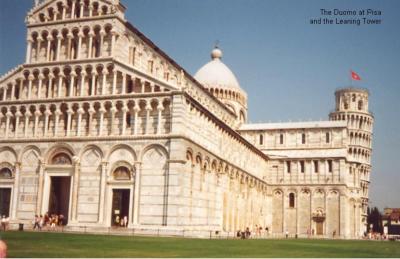
make straight for it and soon find ourselves in the Campo dei Miracoli (The Field of Miracles),
containing the Duomo, the Babtistry and of course, the Torre Pendente (Leaning Tower).
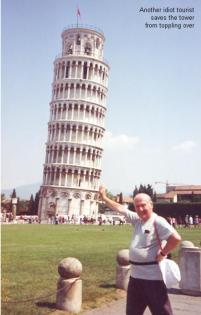
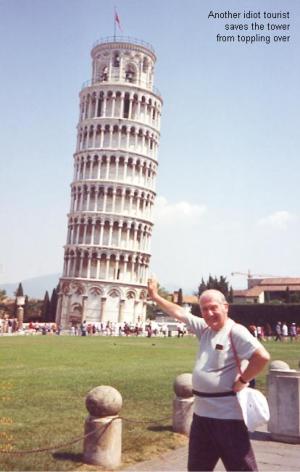
All the buildings of the Campo dei Miracoli lean because of
their shallow foundations and sandy subsoil, but none tilts so
famously as the tower. Begun in 1173, the tower began to tip
sideways before the third storey was completed. Even so,
construction continued until its completion in 1350. As
building proceeded attempts were made to correct the angle
by using bigger blocks on one side, so the tower finished up
with a bit of a kink in it. By 1817 the top of the tower was 3.8
metres (12.6 ft) from the vertical, and by 1993 this had increased to 5.4
metres (17.5 ft) !
It was in danger of falling over and was closed. A committee of Italian
engineers came up with a scheme involving giant lead weights on one side of
the tower, but all this achieved was an ugly tower. It continued to lean at a
dangerous angle. A British engineer joined the committee and persuaded them
that the only way to save the tower was to drill a inclined holes underneath
the foundations on one side, and pump out some of the sand and silt from
beneath; the theory was that the sand and clay above the pumping operation would gradually
subside to fill the voids, taking that side of the tower with it.
It worked! The tower returned to a safe angle this year.
(Of course, nobody was attempting to completely correct the angle of this important tourist
attraction - "Oh, Darling - we must go and see the upright tower of Pisa!")
Urine in Italy now!
On our drive back to the hotel I am mystified as to why, just outside one town, a car on the
other side of the road has suddenly stopped, with a procession of (now stationary) cars behind
it. The driver who has caused this sudden screeching of brakes and considerable tail-back, has
leaped out of his car and is now standing behind a rubbish bin at the side of the road having a
much needed pee.
Now, in Italy, the shortest measurable period of time is that between a red traffic light changing
to green and the man behind you putting his hand on the horn. And yet, under these particular
circumstances, all the traffic came to a polite halt and just sat there waiting for this guy to get
back into his car, suitably relieved, and drive off. (Only in Italy!)
Sunday 27th August and it's our last full day in Tuscany. We decide to revisit to Colle Val
D'Elsa with lunch outside the little café bar. Tomorrow we start our return home with a 250 mile
drive to the north of Italy.
I polish off the Michelangelo biography. (A talented painter and sculptor, he somehow managed
to keep Dukes and Popes sometimes happy, sometimes angry by promising complex works that
took him on journeys between Florence and Rome, never quite completing much of the work
because of other commitments - much like today’s builders! He reached a ripe old age, with the
accent on "ripe" as he followed his father's advice never to wash if he wanted to stay healthy!
The Journey home, via Lake Maggiore, Switzerland, and France ..
From Yorkshire Pudding to Pizza in Pisa
Come with me to Italy. I'm afraid the transport is somewhat basic: you’ll be riding on the back of
my words. Hold tight! I’ll write carefully, trying not take too many sudden diversions, and
avoiding unexpected full stops.
Going off the Rails
Mental contortions! Booking a place on Belgian Railways "Motorail" - or as they call it, the
"Autotrein". It’s not possible to make reservations more than 6 months in advance. I telephone
Belgian Railways in London as soon as I’m in the 6-month time frame and make the booking. We
intend to get the train from Denderlooew (near Brussels) to Livorno in Northern Italy (near
Pisa).
Weeks go by and no word from Belgian Railways. I email them and they reply that our booking
request has been "placed in a queue in Brussels". "There is every chance you will get on this
train". This does not fill me with confidence.
Belgian Bonhomie
The rail tickets arrive! But - what's this? .. there is one for us and one for the car - fair enough -
but they have different train numbers on them. I imagine us heading off in one direction and our
car in another. I email my (by now) familiar Belgian Rail contact, and ask if I should be
concerned. He replies ..
"We will ask Hercule Poirot to investigate this mystery. Sorry, this is just my weird Belgian
sense of humour. It is perfectly normal to have different train numbers for passengers and cars
whilst still indicating the same train ... but only in Belgium!
Kind regards, Daniel Mahr.”
A1 South
We've paid £17 for a Swiss Motorway pass. It's valid for a year, but we’ll only use it for one day;
but it's a one year pass or nothing - Swiss Justice! We've also become temporary millionaires:
this is just before the Euro, so we have 1.5 million Italian Lire between us! (£1 is approx 3,000
Lire.)
It's Saturday 18th August and we are off to Folkestone on the south coast for an overnight
stop before driving on to Le Shuttle to take us under the English Channel.
We shall take the A1 south, then M11 to the London area and M25 then M20 to Folkestone. At
the start of one section of the A1 in Lincolnshire I see a sign ..
Being in possession of a notoriously attention-seeking bladder on long journeys, I take
this as sound advice!
At a roadside restaurant for lunch I decide to start our Italian experience early by having
Chicken Fusilli (noting the invaluable information on the menu that Chicken Fusilli is also
available "without the chicken"!).
It's 7 pm as we turn off the M20 into Folkestone after a pleasantly unhurried 300-mile journey.
Rough Start to a Smooth Crossing
It's Sunday 19th August, and it’s 6 am; I've just had a nasty feeling that the train I had
booked for the channel crossing might not give us enough time on the other side to reach
Denderlooew in time for the Autotrein.
I want to catch an earlier train so we are heading for the Tunnel Terminal an
hour earlier than planned. Sod's Law comes into play. We arrive and are told:
"Normal service has been suspended. Train stopped in tunnel." A group
of illegal immigrants from Calais have been discovered walking the tunnel.
(Good grief! Do these people realise this is a 25 mile walk - in a tunnel - with
trains thundering by at 70 mph every 15 minutes?)
After sitting around for a bit, panicking about missing our Autotrein, we’re told that things are
getting back to normal and we can catch the 8.20 train. This was the train I had originally
booked! We get an uneventful journey under the Channel and an easy 100 mile drive on the
French and Belgian Autoroutes to Denderlooew.
(Years ago, when we made our first trip to France with a car, driving on the "wrong" - that is to
say, the right hand side of the road filled me with terror, and my fear and tension stayed with
me for nearly an hour's driving. Now I find that within a couple of minutes driving I'm quite
relaxed and comfortable.)
Railway Tracks and Sleepers
The Autotrein terminal is an interesting experience. We are parked up on a large concrete apron,
through which the railway tracks run (like your average level crossing) and there is a motorised
ramp being manoeuvred up to the end of a line of double-decker car transporter wagons. Some
wagons are for Rome, others for Livorno (our destination). The cars have to be loaded in the
right order on to the right wagons.
I get the car on to the wagon and return to the departure lounge. Meanwhile,
after all the cars have been loaded and secured, a little diesel shunter rumbles
up and hauls the car wagons away up the line. Goodbye, cars.
We walk through a tunnel to the main station and find our train waiting. The car
section of the train has by now been taken up the line to a junction and is now
being shunted back down to us and coupled up to the end of our train. Hello,
cars.
Each carriage has its own steward (multi-lingual). Ours is a Flemish speaking
Belgian who speaks good English, and he shows us to our cabin. In it's day-time
mode the cabin has comfortable seats, coat hooks, a storage shelf, and a
washbasin with hot and cold running water. Above the shelf are cupboards and these include
two sealed plastic cups of water for teeth cleaning.
We pull out on time at 2.20 pm, and start our long journey. The steward brings us each a
complimentary glass of wine - a good start!
Our train will spend the rest of the afternoon trundling through Brussels (Bruxelles), Namur and
Dinante, before crossing into France for Thionville and Strasbourg, (by which time it is early
evening, since we have had an unexplained stop for an hour near Namur).
The train has been displaying some impressive turns of speed but unfortunately round some
equally impressive curves, leading to hairy moments whilst negotiating the corridors for toilets,
and indeed heading for the restaurant car at about 7 pm. The restaurant car is a delight of
modern décor, with attractive lighting, and a creative table layout that includes tables for four,
two, and even single people.
The dinner menu is in several languages, including English. The Parma ham and melon, followed
by steak in peppered sauce, and a bottle of Chardonnay satisfy hunger and thirst more than
adequately, and the waiters somehow contrive to stay on their feet whilst serving food and drink
as we negotiate more curves at about 80 mph.
On our return to our cabin a we find that the steward has converted the seating into two bunk
beds, one above the other, and a ladder fixed in place. Although I am happy with the concept of
"women on top", I climbed the ladder as we hurtled round several more bends.
An interesting night! The train is travelling at speed, the track doesn't get any straighter (quite
the opposite), and there are frequent tunnels. It’s hot, and the air conditioning is on the blink, so
we open the window. This results in incredibly high noise levels, especially in and out of the
tunnels as we speed through the blackness of nocturnal Switzerland, swallowing up Basel, Bern,
and Brig.
To add to the noise comes a severe electrical storm so the cabin is lit by occasional blue flashes.
The whooshing of the tunnels is augmented by rumbles and bangs. Stir into this cocktail the fact
that we are now lying in bunks across the width of the cabin, and travelling at about 80 mph at
900 to our line of travel. As we take each one of the many bends centrifugal force slide us first to
one end of the bed, then to the other, alternately banging feet and heads against opposite cabin
walls.
Sleep comes and goes, interspersed with quiet periods at a standstill in some station or other,
listening in semi-consciousness to station announcements, sometimes in French, sometimes in
German. Then we’re hurtling through the night again, but eventually there are glimmers of early
daylight and we stumble out of the bunks and do our best to wash and dress in the confined
space. As we penetrate more and more tunnels entering northern Italy we lurch down the
corridor again to the restaurant car for breakfast.
The scenery outside is staggering. High mountains, and the typical architecture of Italian towns
climbing up them on one side of us, and the waters of the Rivereria di Levante on the other, as
we negotiate the area round Genoa and La Spezia. It's a spectacular accompaniment to our
breakfast of coffee, croissants and jam.
Now the train has stopped at Pisa Station - quite the scruffiest looking station I have ever seen -
and we are standing in the corridor watching people getting on and off the early morning
commuter trains. We wonder if we’ll see the famous leaning tower as we pull out of the station,
but all we get is industrial estates.
It's now nine o'clock in the morning of Monday 20th August as we pull into Livorno. This is
where we get off, and we should have arrived here at 7.30 am. Still, being used to the chaotic
system that passes for train travel in Britain, this almost feels punctual!
We hump our luggage on to the platform and there's a station announcement in three languages
- "Collect cars at the ramp". This is useful but for the fact that nobody knows where the ramp is,
(or indeed what it is). Welcome to Italy. It is already very warm.
Now there are people wandering about lugging suitcases saying to each other "Where the hell do
we pick up our cars?" Someone finds an official who tells us where "The Ramp" is and off we
troop. The car transporter wagons for Livorno are shunted off the end of our train, taken down
the line, then back up on another line, arriving at "The Ramp". Meanwhile, the train that has
been our moving home for 17 hours pulls out, heading for Rome.
Driving on the Right, & trying to keep out of the Wrong, in Italy
Monday 20th August.
With a head full of stories and rumours about the lethal nature of Italian driving I drive nervously
out of Livorno station relying on my instinctive internal navigation system. (The map of Livorno
provided by Belgian Railways is useless as there’s no indication where the roads are heading as
they fall off the edge of the map.)
We see a signpost for Rome, and we remember that this road will take us to where we can pick
up the rural road for our destination - Casole d'Elsa and the Hotel Gemini.
We have a 60-mile drive to our hotel, and we have all day to do it in. I have already been hooted
at by an impatient gesticulating Italian driver as I attempted to find the right road out of
Livorno. Soon the universal disregard for speed limits, and the popular past-time of driving as
close as possible to the car in front ceases to cause panic, as we get into the Italian swing of
things.
We see little in the way of road repair works in Italy, but they need them. The rural roads have a
marked tendency to crumble away at the edges, and the Italian highway authorities simply erect
road signs showing a picture of a road with the edge crumbling away, and they are permanent
signs! If you think British roads have too many bends, try the rural Italian ones (and this is the
home of the ancient Romans who took the shortest distance between two points, thus inventing
the straight line!) The "Autostrada" (the toll motorways) on the other hand, are superb.
The scenery is great, and we are (of necessity) driving slowly enough to enjoy it: rolling hills,
rows of cypress trees; mediaeval towns perched on hill tops, with the road winding up and up,
hairpin bend after hairpin bed to the edge of town, then down the other side in similar manner.
We stop for a break on a hill top and survey the hot, shimmering countryside. The noise of
millions of crickets in the grasses is amazing - difficult to describe in words - a bit like several
hundred football referees blowing their whistles from somewhere about 2 miles away. There is
not a cloud in the sky and the sun is burning down mercilessly. We cannot remember when we
were last as hot as this. Thank God for Climate Control in the car!
Onwards to the mediaeval town of Volterra and beyond, and by midday we
are pulling into Casole d'Elsa and the Hotel Gemini - at first sight a small
single-storey building when viewed from the front. But it is built into a hill
side and the ground falls away sharply behind the hotel, so that in fact there
are two more floors - below the reception, lounge and dining areas - which
you cannot see from the front. So, after registering we take the lift down
two floors to our bedroom. It's a large and airy cool room and, having gone
down two floors, we discover that the large French windows open out
directly on to a level garden. We have our own little patio, with chairs and table, from which
we can view the swimming pool.
Strength in Numbers
Lunch in the hotel restaurant. I learn to say our room number in Italian for the benefit of the
waiter, (due-zero-quattro) and he proudly translates it back into English as two zero five so then
I have to advise him that it is two zero four so he rolls that off his tongue a couple of times and
is then very happy. I order duck in orange sauce. Potatoes only seem to be available in one form
- so we ask for the patate fritte - which the waiter triumphantly confirms as - "chips!" (This is
going to be a little ritual performed every evening at dinner.)
My Italian is like my French and my German - phrase book stuff. But I can pull off a fairly
convincing accent, sadly thus appearing to be more fluent than I really am. Frequent use of the
phrase of "Scusi, non parlo Italiano molte bene" invariably elicits a response that I don't fully
understand but clearly indicates something along the lines of "On the contrary, you speak it
very well! Much better than my English in fact!" After this they are waiting for you to continue
with your obvious fluency. The trouble with learning useful phrases and questions is that
however well you deliver them, there's an even chance you won't understand the answers!
Still, my luck is in as I approach the Receptionist, requiring a couple of extra pillows in the
bedroom. I have rehearsed "Scusi, possiamo avere due cuscini
supplementare, per piacere" - to which she replies "Si, certamente."
The hotel restaurant opens out on to a terrace providing a breathtaking view
of the Tuscan countryside, so we choose to sit outside. We have dinner
(parma ham and melon, followed by smoked swordfish, vegetables (and
Chips!) with, of course, a bottle of Chianti) sitting under a darkening purple
sky in which hangs a thin crescent moon. There is a warm breeze. Absolute
bliss.
City of Towers
It's a hot and sunny Tuesday and it’s half and hour's drive to the medieval town of San
Gimignano. In the 13th century this town boasted 76 towers serving both as fortresses and
symbols of private wealth. Today there are only 14 remaining, but they still make a spectacular
sight.
It’s a tourist trap par excellence and at 10 am approach roads are already very busy, and the car
parks on the outskirts of the town are nearly full. This place is a web of narrow streets and
alleyways, and except for those belonging to local residents
no cars are permitted.
Oops! - the notorious bladder calls for attention, and as
luck would have it there are public toilets near one of the
entrances to the town. But what's this old guy doing sitting
at a table outside? Collecting money from all these people
with crossed legs queuing, that's what he's doing. I ask him
how much; he just shrugs his shoulders. Peering (no, not
peeing) into the box on his table I see a large collection of
1,000 lire notes, so that is what I give him. Well in terms of
facilities and cleanliness it was well worth the money.
(About 30 pence). But there's a big surprise for the ladies -
instead of the expected lavatory bowl and seat there are
those traditional "hole-in the-floor-stand-and-squat"
arrangements so well known in some rural parts of France.
Some Japanese ladies came out of the place in a visible state of shock.
Forgive me for waxing lyrical on things anal, but I feel obliged to record that after our
expedition to the Czech Republic the previous year - where the texture of toilet paper was
somewhere between that of a cheap kitchen roll and a brown paper bag - the Italian variety
provides an acceptable experience.
We spend the day wandering the ancient and narrow streets, and we include a contemplative
visit to the Basilica. Here I light a candle for all who are dear to me - well, not exactly a candle -
here in this mediaeval cathedral you pop a coin in a slot and an electric "candle" is switched on!
Lunch in a little ristorante opening out on to the street. As a somewhat perverse aid to post-
lunch digestion we decide to visit the Museum of Inquisition Torture and Capital
Punishment, where our senses are assaulted by displays of the most appalling instruments of
torture used through the ages, in Italy, and world wide. Even more disturbing are the graphic
descriptions of how and why they were used, and how long the victims usually took to die. It is
difficult to place these things in any order of awfulness, though I think the one at the top of my
personal list is the tall upturned tapered spike, on top of which the victim is sits, waiting to
submit to the laws of gravity.
Later we suffer another form of torture: Ordeal by Rejected Credit Card. We want to buy a set of
unframed prints of Tuscan scenes. The shop owner takes my credit card, swipes it through his
scanner and it’s rejected. I proffer a second card - same result. Same with the third and fourth
cards. I wonder if someone has raided my bank and credit card accounts; the apologetic shop
keeper assures us this is a fault in the Italian telephone system! I have some £ sterling, so off
we go to a bureau de change across the street and change it to God knows how many hundreds
of thousands of Lire, return to the shop and pay for the pictures with cash.
We return to our hotel for our evening dinner on the terrace - rabbit in truffle sauce (oh, and
Chips!)
Bread - the Tuscan Variety of Pane is a Pain
Wednesday 22nd August, and we decide to stay local. We wander round Casole D'Elsa, look in
on a small supermarket and buy ourselves a "picnic" lunch to eat in the hotel garden.
We have already noticed at breakfast that Tuscan bread leaves much to be desired. It is dry and
tasteless. (We learned later that it is normally like this, having no salt in it, and is also baked in a
way that produces a rock hard crust.)
In our quest for a picnic lunch we examine the bread counter in the local supermarket. I pick up
a long loaf, and waving it around, remark, "I could kill someone with this!" Fortunately, nobody
here speaks English.
In the hot afternoon I decide to splash around in the hotel's outdoor swimming pool. The air
temperature is so high that the water seems unpleasantly cold at first, and my important bits
shrink even smaller than they already are. But I soon get used it.
A Fool and His Money are Soon Parted
Thursday 23rd August. We are going to visit Florence. (I hope she's in.) It’s a
50 minutes drive; we’ve studied the city maps for car parks. On arrival we find
the road leading up to the Piazzala Michelangelo, high on a hill overlooking the
city. Again, not a cloud in the sky and the sun is beating down. We are going to
need our sun hats, especially with my bald bonce.
As soon as we park the car we are the victims of a scam. A “car park attendant”
waves us into a vacant spot, writes out a ticket, sticks it on our windscreen, and says in good
English, "30,000 Lire for the day please". This is about £10, but what the hell, this is Florence
(Firenze) and it's bound to be expensive.
Another English car drives up beside us. The guy gets out and says, "You didn't pay him, did
you?"
"Well, yes, actually."
"It's all free in this spot. You see the white squares? That's free parking. You only pay where
there are blue squares."
"So where are the blue squares?"
"There aren't any!"
"Aaaargh!!"
By now we have just clapped eyes on the view - the whole of Florence spread out beneath us,
with the dome of the huge Duomo (cathedral) dominating the picture, and we can see the
famous Ponte Vecchio - the oldest bridge in Florence, (crossing the River Arno), built in 1345,
with shops and buildings on it These were originally butchers, tanners, and blacksmiths, but they
were evicted by Duke Fernando in 1593 because of the noise and the stench. Nearly all of these
buildings are now jewellery shops. Suddenly it almost seems worth 30,000 Lire.
Across the Ponte Vecchio we go, and then into the city. All the police that were needed up on the
hill are down here in the town; on every street corner, chatting and smoking: Carabinieri - the
armed "military" police with red-striped blue trousers and peaked caps; (they deal with a variety
of offences from theft to speeding); La polizia - the state police with blue uniforms, white belts
and berets; (they specialise in serious crimes). And the Vigili Urbani - the municipal police with
blue uniforms and white helmets (same shape as the British Police helmet); (they regulate street
traffic). There are a lot of females in this last group, and they all seem to have shoulder length
hair, looking very odd when topped with a tall white helmet! With all three varieties of police it
seemed to me there was a good case for a fourth - perhaps the Vigili Parcheggio? (Parking Lot
Cops?).
The Duomo, or cathedral, is colossal, but the close configuration of the surrounding streets
makes it impossible to see it all at once. Our first sight of the front is an amazing assault on the
senses - gleaming black and white marble. We join the queue to get inside. The main sense
inside is one of an awesome space, (it can accommodate 20,000 people) but having already
seen the startlingly ornate exterior, the interior appears to be quite plain by contrast.
We light a candle for Jacqueline.
Dante's house is quite close by, but being very hot, and short of time, we didn't see it - an
infernal disappointment.
Next to the cathedral is the Campanile, or Bell Tower, 276 ft high - again black and white marble.
I slog up to the top - 414 steps! Stunning view, buggered legs.
It's time to find somewhere for some lunch before we collapse from heat
exhaustion. So we return to the river, near the Ponte Vecchio and find a riverside
bar where we have a cold beer to wash down a toasted wild boar ham and
tomato roll, whilst listening to four American women on the next table alternating
between English and fluent Italian.
Then we retrace our steps in the direction of the Duomo, this time taking in the
Piazza della Signoria and the Palazzo Vecchio, outside which we can feast our
eyes on Ammannati's Neptune Fountain and Michelangelo's David. Inside the
Palazzo is a museum, and we try to get in, but - hey! - this is Italy, in the height
of the tourist season, in the middle of the week, and so the museum is about to
be closed for the afternoon! Unbelievable! Still, the shop is still open, so we can
buy books on Leonardo da Vinci and Michelangelo.
After rubbing the nose of the lucky bronze boar in the nearby marketplace we re-
cross the Ponte Vecchio and make our way to the Palazzo Pitti where we collapse
gratefully into an air-conditioned café for fruit tart and coffee.
Our car - after the rigours of being on a railway transporter wagon's lower deck through
thunderstorms, and subsequent storage in the very dusty hotel car park - is by now disgustingly
filthy, so on the way back we pull in at a garage and put it through a car wash. This removes the
dust, but there are still rusty looking stains on it from the train journey. Back in the hotel by 6
pm Dinner on the terrace by moonlight.
Australian in Siena
It's Friday 24th August and still sunny and very hot. We spend the morning in the hotel
garden; I position myself under the shade of a small tree and get stuck into the biography of
Michelangelo.
We decide to skip lunch and take a half hour drive south to the ancient town of Siena, parking
the car outside the old city walls and walking through the city gate and down one of the narrow
streets that form a kind of web radiating out from the central Piazza del Campo. These streets
are no-go zones for cars but of course there is always the ubiquitous motor scooter. There are
more of these in Italy than you can shake a stick at, and are constant noisy hazard sounding like
bees in a jam pot, in the narrow streets and alleys of mediaeval towns.
The Piazzo del Campo is surrounded by bars with chairs and tables under
awnings and sunshades outside. Collapsing gratefully into chairs outside one of
these bars I summon up my best Italian to order a couple of beers. An
Australian accent you could cut wood with came back ... "D'ya wanna do this
the Italian way or the English way?". We opt for the English way! (What's the
point of trying to talk Italian to an Australian?)
The Duomo is another black and white marble marvel, and inside there is a
fantastic inlaid illustrated marble floor. Unlike the Duomo in Florence, this is one is as startlingly
beautiful inside as outside.
I sit down in the main body of the cathedral to rest the poor old pins and to study all the
international tourists. An American is carrying around one of these tape-recorded information
systems. He approaches a member of the cathedral staff and is clearly agitated ...
This system is broken - I want my money back. I can't wait for a replacement, because
I have to go and meet someone."
"How much have you heard?"
"I guess about half."
"Come back again tomorrow and you can hear the other half."
We leave the cathedral before World War III breaks out. The rain is now coming down in lumps,
but soon stops.
We drive back to the hotel via a medieval hill-top town called Colle di Val D'Elsa, and decided to
stop there for our evening meal. (Arnolfo di Cambio, the man who built the Palazzo Vecchio in
Florence, was born here in 1232.)
We walk into a little square shaded by trees. The entrance to the old town proper is
through an archway going right through the middle of an old house that straddles the
road.
A couple of hundred yards down the main street we come across another little square
surrounded by ancient houses with tiny windows. On one side is a little café bar with a few
chairs and tables outside. It is clearly a popular little haunt of the local townspeople, so
we decide this is going to be the place for a simple meal this evening.
Out come the cold beers, of course, and I choose a vast selection of pieces of local
cheeses arrayed in a circle around the plate, and a great pile of sliced Tuscan bread (no
butter). The cheeses were very good and compensated for the bread!. My wife had a ham
and cheese toasted roll. She conclude that toasting Tuscan bread brings about some
improvement. I'm driving, so no more drink for me, but my good lady (having demolished
a large beer) decides to have a glass of wine. The climax to this simple repast are two
large chocolate ice creams swimming in Grand Marnier liqueur, accompanied by cups of coffee.
All this comes to a mere 47,500 lire, i.e., about £7.50 each for a great little meal, sitting outside
in a sunlit square surrounded by ancient buildings with character occupied by interesting
characters!
As Big Ben said to the Tower of Pisa, "I've got the time if you've got the inclination".
It's Saturday 26th August, - hotter than ever! We can't leave Italy without seeing the leaning
tower of Pisa, and this is our longest drive of the week, but the countryside is great and we pass
through some nice little towns and villages.
Two hours later we are in Pisa, and I've left the street map behind, so we are wandering around
looking in vain for a tower, leaning or otherwise. Because of the narrow streets it is difficult to
look for landmarks. We've nearly given up when suddenly we just see the top of the tower, so we
make straight for it and soon find ourselves in the Campo dei Miracoli (The Field of Miracles),
containing the Duomo, the Babtistry and of course, the Torre Pendente (Leaning Tower).
All the buildings of the Campo dei Miracoli lean because of
their shallow foundations and sandy subsoil, but none tilts so
famously as the tower. Begun in 1173, the tower began to tip
sideways before the third storey was completed. Even so,
construction continued until its completion in 1350. As
building proceeded attempts were made to correct the angle
by using bigger blocks on one side, so the tower finished up
with a bit of a kink in it. By 1817 the top of the tower was 3.8
metres (12.6 ft) from the vertical, and by 1993 this had increased to 5.4
metres (17.5 ft) !
It was in danger of falling over and was closed. A committee of Italian
engineers came up with a scheme involving giant lead weights on one side of
the tower, but all this achieved was an ugly tower. It continued to lean at a
dangerous angle. A British engineer joined the committee and persuaded them
that the only way to save the tower was to drill a inclined holes underneath
the foundations on one side, and pump out some of the sand and silt from
beneath; the theory was that the sand and clay above the pumping operation would gradually
subside to fill the voids, taking that side of the tower with it.
It worked! The tower returned to a safe angle this year.
(Of course, nobody was attempting to completely correct the angle of this important tourist
attraction - "Oh, Darling - we must go and see the upright tower of Pisa!")
Urine in Italy now!
On our drive back to the hotel I am mystified as to why, just outside one town, a car on the
other side of the road has suddenly stopped, with a procession of (now stationary) cars behind
it. The driver who has caused this sudden screeching of brakes and considerable tail-back, has
leaped out of his car and is now standing behind a rubbish bin at the side of the road having a
much needed pee.
Now, in Italy, the shortest measurable period of time is that between a red traffic light changing
to green and the man behind you putting his hand on the horn. And yet, under these particular
circumstances, all the traffic came to a polite halt and just sat there waiting for this guy to get
back into his car, suitably relieved, and drive off. (Only in Italy!)
Sunday 27th August and it's our last full day in Tuscany. We decide to revisit to Colle Val
D'Elsa with lunch outside the little café bar. Tomorrow we start our return home with a 250 mile
drive to the north of Italy.
I polish off the Michelangelo biography. (A talented painter and sculptor, he somehow managed
to keep Dukes and Popes sometimes happy, sometimes angry by promising complex works that
took him on journeys between Florence and Rome, never quite completing much of the work
because of other commitments - much like today’s builders! He reached a ripe old age, with the
accent on "ripe" as he followed his father's advice never to wash if he wanted to stay healthy!
The Journey home, via Lake Maggiore, Switzerland, and France ..
 From North Yorkshire to Italy by Car & Motorail, returning by Car via Switzerland & France

 Click to enlarge
 Click to enlarge
 Click to enlarge
 Click to enlarge
 Click to enlarge
Click to enlarge
Click to enlarge
 Click to enlarge
 Click to enlarge
 Click to enlarge
 Click to enlarge
 Click to enlarge
 Click to enlarge






Le Shuttle to Calais
Belgian Autotrein, Denderlooew
Livorno, Italy
Casole d’Elsa, Italy
San Gimignano, Italy
Florence, Italy
Siena, Italy
Colle Val d’Elsa, Italy
Pisa, Italy
Autostrada to northern Italy
Stresa & Lake Maggiore, Italy
Switzerland
Brig, Switzerland
Grimsel Pass, Switzerland
Brunig, Switzerland
Meiringen, Switzerland
France
Chaumont, France
Calais, France
Le Shuttle to Folkestone
NATIONAL SERVICE
Two years compulsory
National Service in the
Royal Army Service Corps.
I progress from “Sprog” to
Drill Sergeant in the hell
hole that was 2 Training
Battalion, Willems
Barracks, Aldershot.
All the gory details, plus
photographs.
Keith Pritchard
I met Keith 2009. He
was a Tour Manager for
“Great Rail Journeys”
and he added great
value to our vacation in
France, cruising the river
Rhone on the “Princesse
de Provence”. He read
my page on losing my
daughter and sent me a
poem he wrote some
time ago during a low
period in his own life.
CHEER UP!
Jokes, funny stories
and general lunacy
from a variety of
sources, including
those circulated around
the Web
GEORGE W BUSH
(President of the USA
2000-2008) was
famously inept with the
construction of words and
sentences.
Here are a few examples
at which you can now
laugh with a clear
conscience since he is no
longer in such a powerful
position.
Laugh at the quotes and
be grateful that the USA
now has a President
whose first language is
English!
MAD YEAR 2002
For a couple of years I
kept a diary of some of the
sillier and/or otherwise
noteworthy occurrences
both in the UK and abroad.
This is how 2002 looked
through my jaundiced
eyes. The World in the
year after “9-11”
RHONE CRUISE 2009
A Great Rail Journeys
vacation: Eurostar to Lille,
northern France, TGV to
Lyon, southern France,
and a week’s cruising the
Rhône and Saône on the
Princesse de Provence.
Notes and photographs.
 Click to enlarge
 Click to enlarge
 Click to enlarge
 Click to enlarge
 Click to enlarge
Click to enlarge
Click to enlarge
 Click to enlarge
 Click to enlarge
 Click to enlarge
 Click to enlarge
 Click to enlarge
 Click to enlarge